

PAIN REFRAMED
WHAT MY NECK TAUGHT ME ABOUT GRIEF

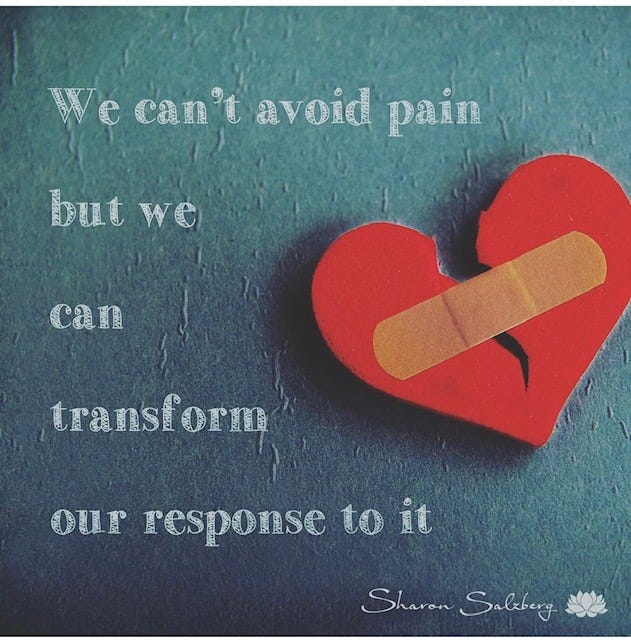
I have to get neck surgery.
It’s the thing I’ve been most trying to avoid, the thing I’ve been most afraid of. It began with a gymnastics injury thirty plus years ago, when I was too young to understand its significance. Over the years, I’ve managed it through massage, stretching, yoga, physical therapy, accupuncture, craniosacral work, chiropractic care, energy work, meditation, and more.
But this time is different.
I am in a level of discomfort that prevents me from sitting, standing, lying down, working, or writing for more than 20 minutes at a time for the last three months.
Sound familiar?
If you’ve ever lived with intense physical pain, even for a short time, I’m sure it does. But I’m also thinking about the emotional pain of grief, and how it bleeds out into our experience of absolutely everything around us. It takes up all the space in our consciousness.
Emotional pain cripples us as much as physical pain.
Grief grabs us by the neck, and love keeps us holding on, as we are thrashed around by loss. The pain commands our full attention. We become myopic. Our vision narrows, the world becomes very small, and the horizon disappears.
In the early days after loss, surviving one day takes every ounce of our energy and attention. It is a constant, moment-to-moment readjustment to attain a tolerable level of comfort through the day and the long, unrelenting night.
As a dear friend described a period of intense grief, “I had no connection to pleasure of any kind. I could recognize what things used to give me pleasure, but the feeling was completely absent during this time. I survived by reminding myself that I had been able to feel pleasure in my life; that the capability still existed. But I had to take that statement on faith.”
To be in barely tolerable discomfort is not a long term solution.
After a certain point, the pain may be familiar, but it’s not sustainable, and it shouldn’t be. And we reach that place in grief where the sharpest intensity has passed. We’re standing- unsteadily but upright- on our own two legs, still in survival mode, and we realize: this is not a life- this cannot go on permanently. The pain of this loss will always be something in my life, but it can’t be everything. I have to try to move some of this misery- to work with it, and to let some of it go. It’s when we begin to clean out the closets, go through some of their personal items, or change the furniture around to better fit our current needs instead of our past ones…..
The work of moving forward onto a path you never chose and actively would give anything to have avoided is hard. It seems antithetical. And yet, survival is our only choice. Life asks us to move forward without them.
So we need to reframe our path forward. Not as disaster, but as the life that is left. As Emily Perl Kingsley writes in her perfect reframe letter, we need to get used to being in Holland when we had planned for being in Italy, and find our place there:
Welcome To Holland
By Emily Perl Kingsley
©1987 by Emily Perl Kingsley. All rights reserved. Reprinted by permission of the author.
I am often asked to describe the experience of raising a child with a disability - to try to help people who have not shared that unique experience to understand it, to imagine how it would feel. It’s like this......
When you’re going to have a baby, it’s like planning a fabulous vacation trip - to Italy. You buy a bunch of guide books and make your wonderful plans. The Coliseum. The Michelangelo David. The gondolas in Venice. You may learn some handy phrases in Italian. It’s all very exciting.
After months of eager anticipation, the day finally arrives. You pack your bags and off you go. Several hours later, the plane lands. The flight attendant comes in and says, “Welcome to Holland.”
“Holland?!?” you say. “What do you mean Holland?? I signed up for Italy! I’m supposed to be in Italy. All my life I’ve dreamed of going to Italy.”
But there’s been a change in the flight plan. They’ve landed in Holland and there you must stay.
The important thing is that they haven’t taken you to a horrible, disgusting, filthy place, full of pestilence, famine and disease. It’s just a different place.
So you must go out and buy new guide books. And you must learn a whole new language. And you will meet a whole new group of people you would never have met.
It’s just a different place. It’s slower-paced than Italy, less flashy than Italy. But after you’ve been there for a while and you catch your breath, you look around.... and you begin to notice that Holland has windmills....and Holland has tulips. Holland even has Rembrandts.
But everyone you know is busy coming and going from Italy... and they’re all bragging about what a wonderful time they had there. And for the rest of your life, you will say “Yes, that’s where I was supposed to go. That’s what I had planned.”
And the pain of that will never, ever, ever, ever go away... because the loss of that dream is a very very significant loss.
But... if you spend your life mourning the fact that you didn’t get to Italy, you may never be free to enjoy the very special, the very lovely things ... about Holland.
Reframing your future after loss is important. It can start simply. Find three things- just three- that feel even slightly okay, or meaningful, or unexpectedly supportive in your current reality. I know 3 may feel like a stretch in relation to the loss, but I urge you to keep your eyes open.
For example, after my mother died by suicide, I felt much closer to my two sisters and father. I experienced a vivid connection to the beauty and power of nature that I hadn’t known before. I felt a deep imperative to communicate and express love to the people in my life. I saw how many of the things that once felt pressing in my daily life just fell away.
These were not replacements for my loss. They existed alongside it.
My reframe on my neck is: I’m too young to live in this level of impairment when there is an option to repair it. I’m doing deferred maintenance and removing outdated machinery. Maybe something got stuck long ago when I landed wrong on that balance beam- a set of beliefs about the importance of my own voice and the expression of my own pain. My need to restrict my own movements in order to accommodate others. As my EMDR therapist says, that’s overdue for re-alchemizing.
So, I get a new neck- a new disc. A new opening. More space where there has been compression. I wonder what it will be like with less pain. I wonder what it will open in me.
I’m looking forward to seeing the horizon again.
I would LOVE to hear from you. How has your emotional pain lived in your body, your days, your life? What has felt heavy, and what, if anything, has surprised you about your post-loss reality? I’m here, and I’m listening :).
Wisdom of Grief is a reader-supported publication. To receive new posts and support my work, consider becoming a paid subscriber.
If you know someone who is grieving who could use support, consider gifting them a paid subscription to Wisdom of Grief on Substack. It might offer comfort, grounding, and lasting impact.
8$/month. $85 for the year.
You can send it with a personal note- or even gift it anonymously. Because we’re in this together.
©Leslie Hunt Palumbo, 2026. All right reserved.
Thanks Leslie ,you have such a beautiful way with words. I wish you a speedy recovery and a life without neck pain. Your new journey begins.